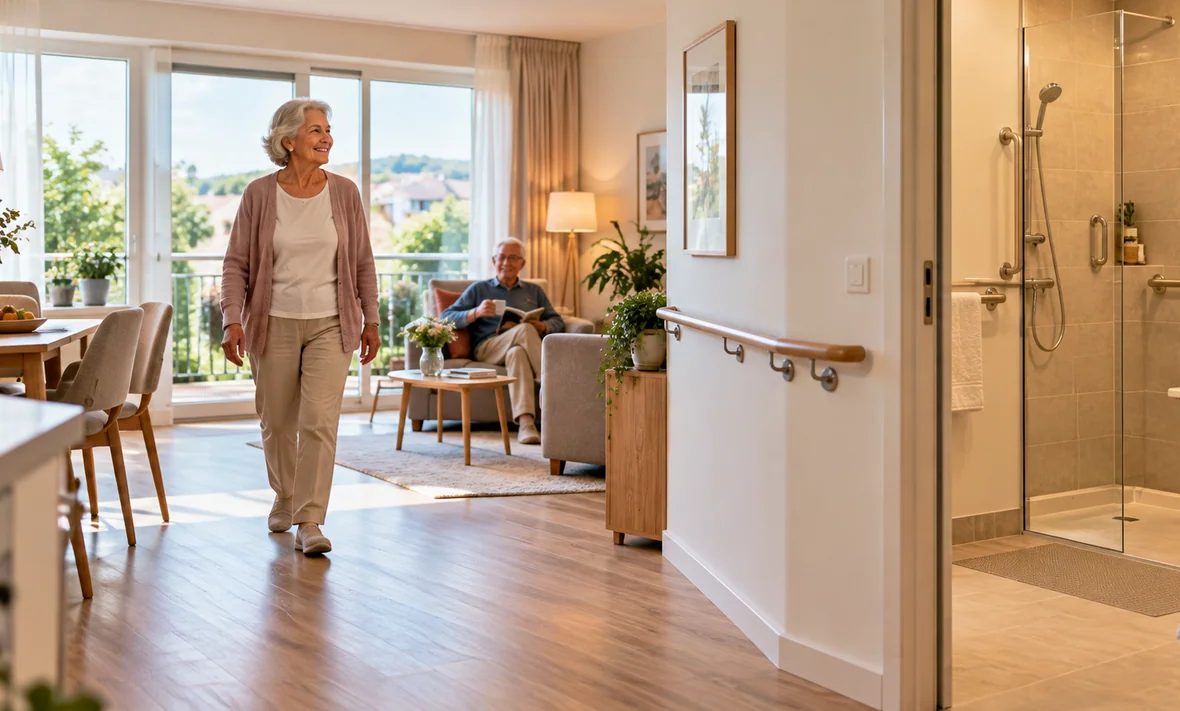
Defining an adapted detached home
An adapted detached home is a single-family house designed or modified for reduced mobility. Typical features include living space on one level, step-free entrances, wide doorways, a walk-in shower, good lighting and controls placed at an accessible height for every occupant.
In France, such houses are often called maisons de plain-pied, meaning single-storey homes. Newer projects add home automation, alarm systems and small, easy-maintenance gardens, while older houses can be adapted progressively according to the changing needs of their occupants.
Who benefits from this model
The model suits older people who remain fairly independent but anticipate future limitations. Couples wishing to keep pets, host grandchildren or garden often prefer a house to an apartment, provided shops, doctors and transport remain within reasonable distance.
It is less suitable for people needing continuous supervision, or for those isolated in rural areas without family nearby. In such situations, a residence with services or shared housing can offer social contact and quicker help in an emergency.
How the model works in practice
Some retirees adapt their current house after an assessment by an occupational therapist. Others buy or rent a new single-storey home, sometimes within clusters known as béguinages, where small houses surround shared spaces and neighbours support each other informally.
Béguinage projects are usually modest in size and may be run by associations, social landlords or private developers. Press articles from SeLoger and Generali explain the concept, its mutual-support philosophy and how it differs from service residences or nursing homes.
Costs and financial support
Adaptation costs depend on the works required, from grab rails to complete bathroom renovation. MaPrimeAdapt’, managed by the national housing agency Anah, can help finance works for eligible older or disabled homeowners and tenants, subject to age, autonomy and income conditions.
The APA autonomy allowance may also contribute to certain equipment, and pension funds sometimes offer advice or grants. Applicants should obtain approval before starting works, because aid is often refused when invoices predate the application file.
The comparison below sets an adapted house against nearby alternatives. Each route has a different balance between independence, cost and support, and many households move through several of them as health and family circumstances change over the years.
| Option | Advantages | Limitations |
|---|---|---|
| Adapting the current house | Familiar surroundings, no move | Layout may limit what is possible |
| Buying a single-storey house | Design suited to ageing | Purchase costs, possible isolation |
| Renting in a béguinage | Community and mutual support | Limited supply, waiting lists |
| Service residence apartment | Services on site | Monthly fees, less private space |
How to apply for adaptation support
The process for public grants follows several stages and requires careful documentation. Having an independent assessment of the home ensures that the works chosen genuinely address risks and remain eligible for financial support from the relevant bodies.
- Request a home assessment by an occupational therapist or approved adviser
- Check eligibility for MaPrimeAdapt’ and other aids
- Obtain detailed quotes from qualified tradespeople
- Submit the application before any works begin
- Complete the works and send invoices for payment
Equivalents in English-speaking countries
In the United Kingdom, bungalows play a similar role, and the Disabled Facilities Grant helps eligible people adapt their homes through local councils. In the United States, single-level ranch houses and age-restricted communities support ageing in place.
Australia and New Zealand offer villas within retirement villages, combining a detached or semi-detached home with shared amenities. Each system has its own funding rules, so readers comparing with France should look at both the purchase model and available grants.
Accessing the French model as a foreigner
Foreign nationals can generally buy property in France through a notary, with no special ownership restrictions. Public aid for adaptation, however, is linked to conditions such as main residence and regular status, so second-home owners usually finance works themselves.
Buyers from abroad should also consider inheritance rules, local taxes and the distance to a hospital before choosing a village. Visiting in winter reveals how quiet some rural areas become and whether essential services remain open throughout the year.
Pitfalls to avoid
Several mistakes undermine the benefits of an adapted house. Many relate to location and timing rather than design, and they become apparent when mobility declines and everyday errands turn into obstacles for the person living alone.
- Choosing a rural location far from shops and medical services
- Starting works before grant approval
- Ignoring garden maintenance in long-term plans
- Overlooking the need for a car if bus links are poor
- Installing equipment without professional advice on real needs
Is a single-storey house enough to age safely?
Living on one level reduces the risk of falls, but safety also depends on lighting, bathroom design and access to help. An alarm service and nearby support network complete the protection offered by an accessible layout.
What is a béguinage?
A béguinage is a small group of homes for older people built around shared spaces, inspired by historic communities in Flanders and northern France. Residents live independently while benefiting from neighbourly mutual support and occasional shared activities.
Can tenants receive MaPrimeAdapt’?
The grant can, under conditions, support tenants as well as owners, usually with the landlord’s agreement for the works. Eligibility rules are set nationally and may evolve, so applicants should verify current criteria with the official adviser network.
Does adaptation increase property value?
Accessible features can attract older buyers, but effects on value vary by market and quality of works. Discreet, well-designed adaptations tend to appeal to more households, whereas highly specialised equipment may need removal when the house is sold.
Sources and organisations
- Changer de logement – résidences autonomie et solutions — Official French portal section, in French, describing housing alternatives for seniors, from independent-living residences to family foster care.
- SeLoger – Béguinage et habitat inclusif — French article explaining béguinage and inclusive housing, with clustered small homes, neighbourly support and generally moderate rents.
- Generali – Seniors : vivre en béguinage — Overview, in French, of how béguinage works for independent seniors, including costs and differences from service residences.