Definition of inclusive housing
The ELAN housing law of 2018 defined inclusive housing as a form of ordinary accommodation, chosen as a main residence by older people or people with disabilities, and accompanied by a shared social-life project. It is neither an institution nor a medical facility.
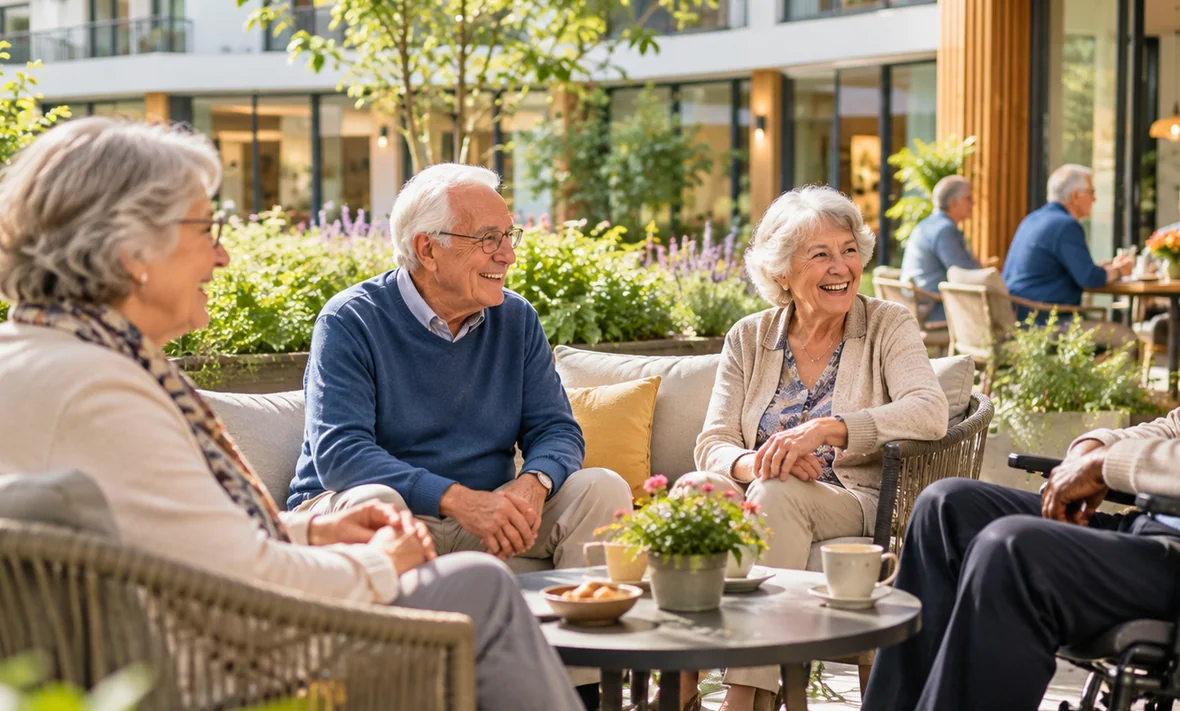
Residents live in individual flats or in a shared house with private rooms, and they meet in common spaces for activities, meals or simply conversation. A coordinator, funded through the project, helps the group organise life together and connects residents with local services.
The approach responds to a gap between living alone at home, which can become isolating, and entering an establishment, which many older people resist. Public authorities have encouraged its development to diversify housing choices for an ageing population.
Who it is intended for
The model targets older people who are still largely autonomous but wish to avoid loneliness, as well as adults with disabilities. Some projects mix both groups. Residents choose to live there freely; admission does not depend on a medical decision or a dependency assessment.
How a project works
A project holder, often an association, a social landlord or a mutual organisation, designs the shared-life project with the residents and the local authority. The housing itself may be rented from a social or private landlord, while the project holder runs activities and coordination.
Each resident signs a lease and remains free to use the care and support services of their choice. Home help, nurses and other professionals come from outside, financed by the usual allowances, which keeps the setting domestic rather than institutional.
The shared-living allowance
Since 2021, an allowance for shared living, known as the AVP, can be paid to residents of approved projects. It does not go directly to the individual: it funds the coordination and the social-life project, under an agreement between the département and the project holder.
Costs for residents
Residents pay rent and charges like any tenant, with housing allowances available depending on income. The shared-living allowance covers the coordination costs rather than rent. Personal care is financed separately, for instance through the personal autonomy allowance or disability compensation benefits.
Overall costs are therefore usually lower than in a service residence, though they vary by project, location and the type of building. Asking for a breakdown of rent, charges and any contribution to common activities helps compare offers on an equal footing.
Comparison with other models
Inclusive housing sits between a private home and a residence with services, with its own legal status. The table compares it with other French models and with arrangements familiar to readers in the United Kingdom, North America and Australia.
| Model | Housing | Shared project | Care provided |
|---|---|---|---|
| Inclusive housing (France) | Private flat or room, lease | Yes, coordinated | External services only |
| Béguinage (France) | Small house in a cluster | Informal neighbourliness | No |
| Résidence autonomie (France) | Flat in a residence | Activities offered | Light support |
| Supported living (UK) | Own tenancy | Varies | Support staff, often visiting |
| Senior cohousing (US, Canada, Australia) | Private home and common house | Resident-led | No |
Equivalents abroad
British supported living separates housing from care in a similar way, although it mainly serves younger adults with disabilities. UK extra care housing adds on-site care staff. North American and Australian senior cohousing shares the community ethos but is usually resident-owned.
Access for foreign residents in France
A foreign retiree living legally in France can apply like anyone else. Where a social landlord provides the housing, the usual social housing conditions apply, including a valid residence permit and income limits. Projects may also ask candidates to share the values of the group.
How to apply
Projects are still relatively few and each has its own process. Most begin with an information meeting, followed by individual interviews and a visit. The steps below summarise the usual path from first contact to moving in.
- Ask the département or local social services for existing projects
- Contact the project holder to request information
- Attend an information meeting and visit the housing
- Prepare a rental application with income documents
- Meet the coordinator and other residents
- Sign the lease and the shared-life charter
Pitfalls to avoid
Inclusive housing works well when residents genuinely want to take part in a collective project. Expectations of continuous care, or a project with fragile funding, can cause disappointment. Ask how long the coordination is financed and what happens if support needs grow.
- Mistaking inclusive housing for a care home
- Not checking the funding period of the coordination
- Overlooking accessibility of common spaces
- Joining without meeting the existing residents
Can a couple move into inclusive housing?
Yes, many projects accept couples, provided the flat suits two people and at least one partner fits the target group. Conditions depend on each project. Couples should ask how the shared-life charter applies to both of them and whether a larger unit is available.
What if a resident needs more care?
Residents can bring in more home-care services as needs grow, financed through the usual allowances. When safety can no longer be guaranteed at home, a move to a specialised facility may be needed. The coordinator often helps families anticipate and organise such transitions.
Is inclusive housing only for older people?
No. The legal definition covers both older people and people with disabilities, and some projects deliberately mix the two. Others focus on a single group. Each project describes its target residents in its shared-life charter and presentation documents.
Where can projects be found?
The official government portal for older people explains the model and lists contacts by département. Local social services, town halls and associations active in disability or ageing also know which projects exist or are under development in their area.
Sources and organisations
- Habitat inclusif : un chez-soi et une vie sociale partagée — Official page on inclusive housing: private home with shared spaces, a shared social-life project and the shared-living allowance.
- Changer de logement – résidences autonomie et solutions — Official section presenting housing options for seniors: independent-living residences, service residences, family foster care and shared housing.