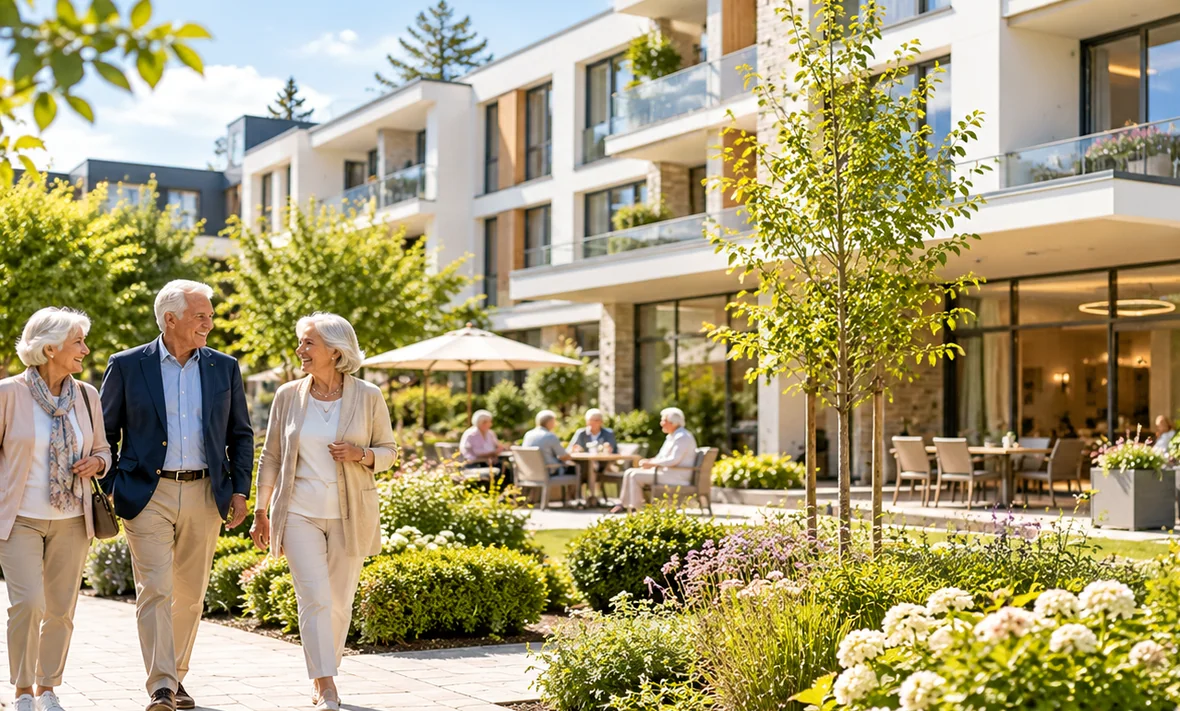
Types of accommodation for older residents
Most Hungarian pensioners live independently in apartments or family houses, but the country also has an established network of idősotthon, residential homes for elderly people. These provide accommodation, meals and nursing assistance, with standards ranging from basic shared rooms to comfortable private units.
Some private homes, particularly around Lake Balaton and in western Hungary near the Austrian border, have developed services for German-speaking residents. They advertise bilingual staff and lower monthly fees than comparable facilities in Germany or Austria, so careful comparison of care levels remains essential.
| Form of housing | Main providers | Considerations |
|---|---|---|
| Independent apartment | Private owners and landlords | Lifts are often missing in older blocks |
| State or municipal idősotthon | Local authorities and state bodies | Long waiting lists, Hungarian-speaking staff |
| Church-run home | Catholic, Reformed and Lutheran organisations | Strong community ethos, places limited |
| Private care home | Commercial operators | Shorter waits, wide price differences |
Who runs care services
Responsibility for social care is shared among the state, municipalities, churches and non-profit organisations, with churches having taken over many institutions in recent years. Private operators complete the picture, especially in tourist areas and around Budapest, where demand from wealthier families is growing.
Home care, meal delivery and signal-alarm systems for people living alone are organised mainly through municipal social services. Foreign residents should ask their local council which services are open to them, as eligibility and fees depend on registration and income assessment.
Residence rights for EU, British and other retirees
Citizens of EU and EEA states can live in Hungary under freedom of movement, registering their residence with the immigration authority after three months. British nationals who arrived after the Brexit transition period are treated as third-country nationals and need a residence permit.
Retirees from the United States, Canada, Australia and other non-EU countries likewise apply for a national residence permit, generally demonstrating sufficient income, accommodation and health insurance. The Hungarian foreign ministry's consular pages outline long-stay visa routes and should be consulted before departure.
Health insurance and medical care
Hungary's public health system is financed through the National Health Insurance Fund, known as NEAK. EU pensioners and many British State Pension recipients can usually register an S1 form, giving access to public care on the same terms as Hungarian insured people.
Public hospitals can be crowded and waiting times long, so many expatriates add private insurance or pay directly for consultations in private clinics, which are numerous in Budapest. Spa towns such as Hévíz also offer rheumatology and rehabilitation services popular with older visitors.
Popular regions, climate and living costs
Hungary has a continental climate with warm summers and cold winters. Budapest suits retirees wanting culture, transport and English-speaking doctors; Lake Balaton offers lakeside villages and summer activity; Sopron, Pécs and Eger combine historic centres with a quieter pace of life.
Groceries, public transport and many services remain affordable compared with western Europe, although inflation has pushed prices up noticeably in recent years. Heating costs deserve attention in older houses, while seasonal resort towns around Balaton can feel empty and under-served in winter.
Checking the contract with a care home
A care home agreement should specify the room type, nursing level, medical supervision, included meals and therapies, and any one-off admission fee. Hungarian homes sometimes request an entry payment, so clarify whether it is refundable when the resident leaves or dies.
Have the contract translated by an independent professional rather than relying on the operator's summary. Check notice periods, price indexation clauses and how the home handles hospital stays. Also check whether your UK pension is uprated in Hungary and compare forint transfer costs.
Steps for choosing and moving
Moving to Hungary goes smoothly when residence, health cover and housing are tackled in a sensible sequence. Visiting care homes unannounced, at different times of day, gives a more honest impression than a scheduled tour with a sales representative.
- Decide between Budapest, Balaton or a smaller historic town
- Check your residence route as EU, British or other national
- Arrange S1 registration or private health insurance
- Visit several homes and request written price lists
- Have contracts translated and reviewed independently
- Register your address and notify pension providers
Typical pitfalls
Expatriates in Hungary frequently report similar difficulties linked to language, paperwork and overly optimistic advertising by private homes. Bearing these points in mind reduces the risk of disappointment, particularly when a relative is choosing care on behalf of a parent from abroad.
- Selecting a home based only on website photographs
- Paying a non-refundable entry fee without legal advice
- Assuming staff speak English or German fluently
- Forgetting to register the S1 with the health fund
- Buying in a resort village that empties out in winter
Are Hungarian care homes cheaper than those in Germany or Austria?
Monthly fees in many Hungarian private homes are lower than in German-speaking countries, which explains their appeal to some families. Lower prices can, however, reflect smaller staff numbers or fewer qualified nurses, so comparing care ratios is more meaningful than comparing totals.
Can a non-Hungarian get a place in a state home?
Access depends on legal residence, local registration and the home's admission criteria, and public places are frequently subject to long waiting lists. Foreigners with legal residence may apply, but many ultimately choose private or church-run homes for faster admission and multilingual staff.
Is Budapest suitable for retirees with limited mobility?
The capital has extensive public transport, including low-floor trams and buses, although some metro stations and older buildings lack lifts. Choosing a modern apartment or a well-located home near medical facilities greatly improves daily life for people with reduced mobility.
Can a German pension or Pflegegrad support help in Hungary?
German long-term care insurance benefits may in certain cases be paid abroad within the EU, mainly as cash allowances. Rules are technical, so anyone in that situation should ask their care insurer in writing before signing a contract with a Hungarian home.
Sources and organisations
- Ministère hongrois des Affaires étrangères – Entrée pour long séjour (plus de 90 jours) — Official Hungarian consular page on visas and residence permits for stays exceeding 90 days for non-EU nationals.