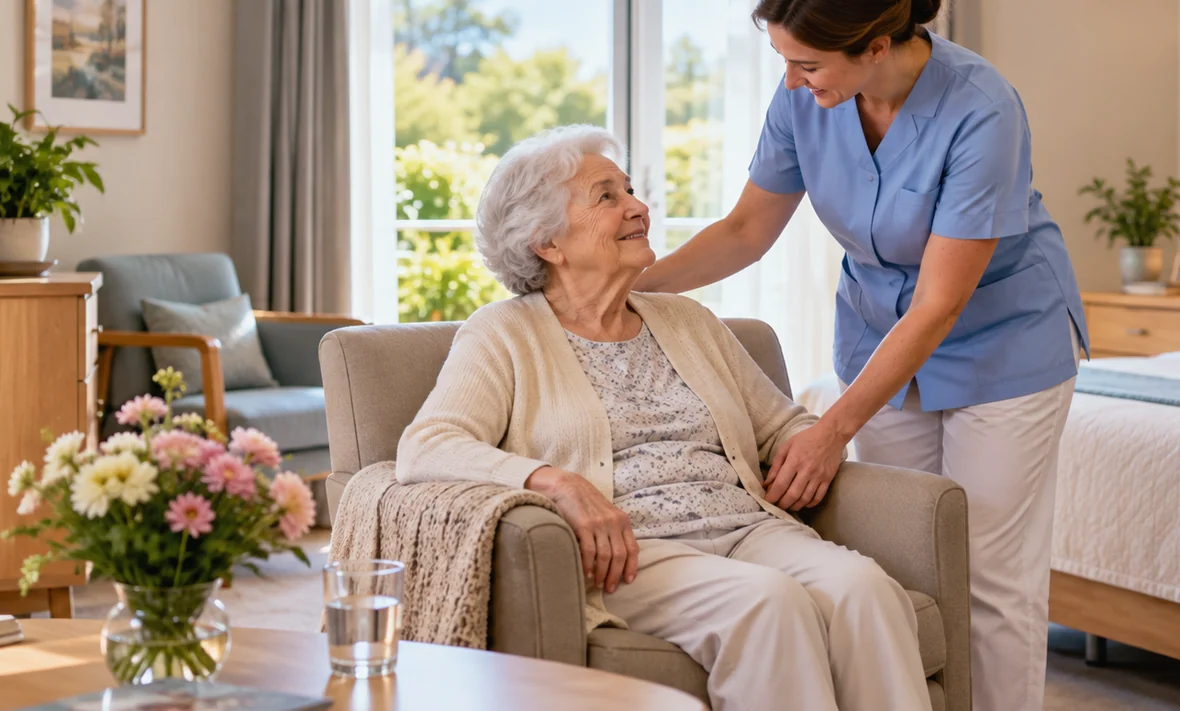
Definition of a medicalised retirement home
EHPAD stands for établissement d'hébergement pour personnes âgées dépendantes. It combines accommodation, meals, help with daily living and medical supervision under a coordinating doctor and a head nurse. Establishments are authorised jointly by the regional health agency and the département council.
Residents are generally aged sixty or over and have lost part of their autonomy. Many homes include a secure unit for people living with Alzheimer's disease or related conditions, where the layout and staffing are adapted to disorientation and wandering.
Who should consider a nursing home
A nursing home becomes relevant when needs are continuous: help with washing, dressing, eating or moving, frequent nursing acts, or a risk of falls that home visits cannot cover. Dependency is measured with the AGGIR grid, from GIR 1, most dependent, to GIR 6.
Where medical needs are even heavier and unstable, French hospitals run long-term care units known as USLD. For people who are still fairly independent, a serviced residence or an independent-living residence is usually more appropriate and considerably less expensive.
The three components of the bill
The daily price is split into three parts. Accommodation covers the room, meals, laundry and activities and is paid by the resident. The dependency tariff depends on the GIR level. The care tariff is funded directly by the national health insurance.
| Component | What it covers | Who pays |
|---|---|---|
| Accommodation | Room, meals, cleaning, activities | Resident, possibly helped by ASH and housing benefit |
| Dependency | Help with daily acts of living | Partly APA in establishment, remainder by resident |
| Care | Nursing, medical coordination, care staff | Health insurance, paid to the establishment |
| Extras | Hairdresser, personal laundry, telephone | Resident |
Aids that reduce the remaining cost
The APA in establishment reduces the dependency part for GIR 1 to 4 residents. Social accommodation aid, ASH, can cover accommodation costs for people with low income in approved homes, but relatives may be asked to contribute and sums can be recovered from the estate.
- Compare prices on the official CNSA price comparator
- Complete the single national admission file, including the medical section
- Submit it online through ViaTrajectoire or directly to several homes
- Request APA, housing benefit and if needed ASH from the relevant bodies
- Visit, meet the director and read the residence contract before accepting
Comparable systems in English-speaking countries
In England the counterpart is a care home with nursing, registered with the Care Quality Commission, while a residential care home provides personal care without nurses. Scotland, Wales and Northern Ireland have their own regulators and funding rules for long-term care.
American readers will know skilled nursing facilities, mainly funded privately or through Medicaid for those who qualify, since Medicare covers only limited short stays after hospital. Canada and Australia rely on provincial or federal subsidised residential aged care with means-tested contributions.
Admission for a family living abroad
Families settled outside France often look for a home near relatives or in the region where the parent once lived. Applications can be filed remotely, but most directors want to meet the future resident or a close relative before confirming a place.
A foreign national lawfully living in France is admitted on the same terms as a French citizen. Public aids such as APA and ASH, however, require regular and stable residence, so arriving directly from abroad usually means paying full price at first.
What to observe during a visit
A visit says more than a brochure. Look at how staff speak to residents, whether people are up and dressed in the late morning, how the dining room feels at lunchtime, and whether the corridors and bedrooms are clean, bright and free of odours.
Ask about staff turnover, the number of night carers, the presence of a psychologist or occupational therapist, and the arrangements with nearby hospitals. A council of residents and families, known as the conseil de la vie sociale, should meet regularly and publish minutes.
Common mistakes when choosing a home
- Comparing only the accommodation price and forgetting the dependency tariff
- Waiting for an emergency hospital discharge before applying anywhere
- Overlooking the distance for visiting family members
- Not asking how the home handles end-of-life care and night staffing
- Signing without checking which extras are charged separately
Frequently asked questions
Families and future residents tend to ask the same practical questions about nursing homes in France, especially regarding waiting lists, cost sharing within the family and the rights of residents once they have moved in.
How long are waiting lists for an EHPAD?
Delays vary widely. Public and non-profit homes in large cities and popular coastal areas can have long lists, while rural establishments sometimes admit within weeks. Applying to several homes at once is normal and does not commit the applicant.
Can children be required to pay?
Under French law adult children and their spouses have a maintenance obligation toward a parent in need. When ASH is requested, the département assesses their resources and may set a contribution, which a family judge can review if contested.
Is a trial stay possible?
Many homes offer temporary accommodation for a few weeks, for example after hospitalisation or to give a family carer a break. A temporary stay is a useful way to test the atmosphere, the food and the relationship with staff.
Does the resident keep the right to choose a doctor?
Yes. Residents may keep their own general practitioner if that doctor agrees to visit the establishment. The coordinating doctor oversees care protocols and medication policy but does not replace the patient's chosen physician, whose role remains central.
Sources and organisations
- Pour les personnes âgées – Prix et comparateurs — Official CNSA portal: nursing-home (EHPAD) price comparator, out-of-pocket costs and national directory of care facilities for older people.
- Comprendre le comparateur de prix des EHPAD — Official guide explaining how to read the EHPAD price comparator: accommodation rate, dependency rate and remaining cost for families.
- Demander l'ASH (aide sociale à l'hébergement) — Official page on the ASH accommodation aid: income conditions, approved facilities, family maintenance obligation and recovery from the estate.