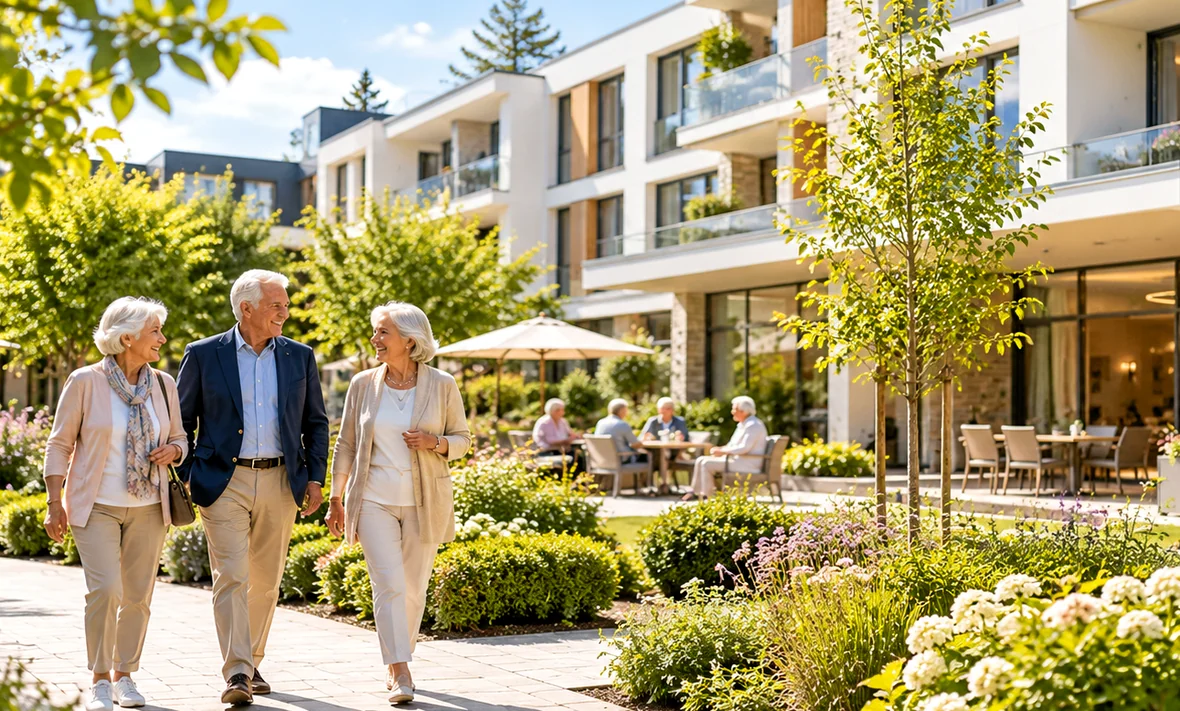
What kinds of senior housing exist in Romania
The Romanian market is dominated by residential care homes, known locally as cămine pentru persoane vârstnice or centre rezidențiale. They provide a room, meals, nursing supervision and help with daily activities, and they mostly serve older people who can no longer live alone safely.
Independent retirement communities of the British or American type are rare. Some private operators near Bucharest, Cluj-Napoca or Brașov offer apartments with optional services, but most active retirees simply rent a flat or house and arrange cleaning, shopping and personal care through local agencies.
Who operates care homes and residences
Public homes are run by county or local social assistance directorates and generally give priority to residents with low income or no family support. Places are allocated after a social assessment, and a monthly contribution is calculated according to the resident and family resources.
Private homes, often run by small companies, churches or associations, have expanded quickly over the last decade. Any provider of social services must hold a licence from the labour and social solidarity authorities, so ask to see the current licence before paying a deposit.
Comparing the main options at a glance
The choice depends on health, budget and how well you cope without speaking Romanian. The table summarises the usual formats; quality varies widely between establishments, so visit in person and talk to residents and staff before deciding on any of them.
| Option | Typical resident | Care level | Points to check |
|---|---|---|---|
| Private rental flat or house | Active, independent retiree | None, add home help if needed | Lease length, heating, lift access |
| Serviced apartment near a city | Independent, wants support on call | Light, optional services | Service fees, ownership of the operator |
| Private care home | Reduced autonomy, needs supervision | Daily personal and nursing care | Licence, staff ratio, doctor visits |
| Public care home | Low income, limited family support | Personal and nursing care | Eligibility, waiting time, contribution |
| Home care agency | Wants to stay at home | Hours of help per week | Contract, replacement staff, references |
Residence rules for foreign retirees
Citizens of the European Union, EEA and Switzerland may live in Romania freely and must register their residence with the General Inspectorate for Immigration after three months. They need proof of sufficient resources and health insurance, which a pension and an S1 form usually cover.
Retirees from the United Kingdom, the United States, Canada or Australia are treated as third-country nationals. They generally need a long-stay visa obtained from a Romanian consulate before arrival, followed by a residence permit, so check current requirements with the consulate well in advance.
Healthcare and insurance for older newcomers
Public healthcare is funded through the National Health Insurance House (CNAS). Pensioners from another EU country who register an S1 form become entitled to care on the same terms as Romanian insured persons, although many residents still use private clinics to avoid queues.
Non-EU retirees normally need comprehensive private health insurance for their visa and permit applications. Private hospital networks in Bucharest, Cluj-Napoca, Timișoara and Iași provide English-speaking doctors, but long-term care is rarely covered by standard policies, so read exclusions on dependency and nursing homes carefully.
Living costs and regions popular with retirees
Everyday expenses such as food, transport and local services remain lower than in most of Western Europe, while rents in central Bucharest and Cluj-Napoca have risen noticeably. Private care home fees vary greatly with location, room type and the level of nursing required.
Transylvanian towns like Sibiu, Brașov and Sighișoara appeal for their preserved old centres and mountain setting. The Black Sea coast around Constanța offers warmer summers, while the continental climate brings cold, snowy winters inland, a factor worth weighing for anyone with reduced mobility.
Contract checks before signing with a residence
Ask for the full contract in Romanian together with a translation you trust, and have it reviewed by a local lawyer. Clarify what the monthly fee covers, how increases are decided, and what happens when the care needs of the resident change significantly.
Check the notice period, the refund rules for deposits and the procedure in case of hospital admission. Verify who signs on behalf of a resident who loses capacity, because Romanian guardianship rules differ from those in common law countries and may require court involvement.
Steps to plan a move to Romania
A gradual approach works best, starting with a long stay before committing to a purchase or a residential place. The following sequence helps foreign retirees organise the move without overlooking the administrative and medical questions that matter most later on.
- Spend several weeks in the region you prefer, ideally in winter as well as summer.
- Confirm your residence route: EU registration or long-stay visa and residence permit.
- Arrange health cover through an S1 form or a private policy before departure.
- Ask your pension provider how payments to Romania work and whether they are uprated.
- Rent first, then visit licensed care homes and home care agencies near your base.
- Prepare a power of attorney and an advance directive recognised in Romania.
Common pitfalls to avoid
Several recurring mistakes cost foreign retirees money or comfort in Romania. Most of them come from assuming that housing, healthcare and legal protection work exactly as they do at home, which is rarely true in the Romanian context.
- Choosing an unlicensed home because it looks pleasant and is cheaper.
- Underestimating the language barrier in hospitals and with local authorities.
- Buying property before living through a full winter in the chosen area.
- Relying on a travel insurance policy instead of genuine long-term health cover.
- Forgetting to register residence or the S1 form after arrival.
Can a foreigner enter a public care home in Romania?
Legally resident foreigners may apply, but places are scarce and allocated after a social inquiry that favours people with low resources. In practice, most foreign retirees with a regular pension will be directed towards private licensed homes, which have shorter waiting times.
Is my UK State Pension uprated if I live in Romania?
Romania is in the European Economic Area, where the UK State Pension has so far been uprated each year under the arrangements agreed after Brexit. Confirm your own situation with the International Pension Centre before moving, especially if your entitlement is unusual.
Do care homes in Romania employ English-speaking staff?
Some private homes in large cities have managers or nurses who speak English, French or German, but day-to-day care staff usually speak only Romanian. Learning basic phrases, or choosing a home where another resident shares your language, makes daily life considerably easier.
What documents should I prepare before moving to Romania?
Bring a valid passport, proof of pension income, recent bank statements, a health insurance certificate or S1 form, and medical records with a list of current treatments. Official documents may need an apostille and a certified Romanian translation for local administrative procedures.